
Sleep & Weight Connection
What the Scale Misses After a Restless Night
Tobias Whitfield·
·
9 min read
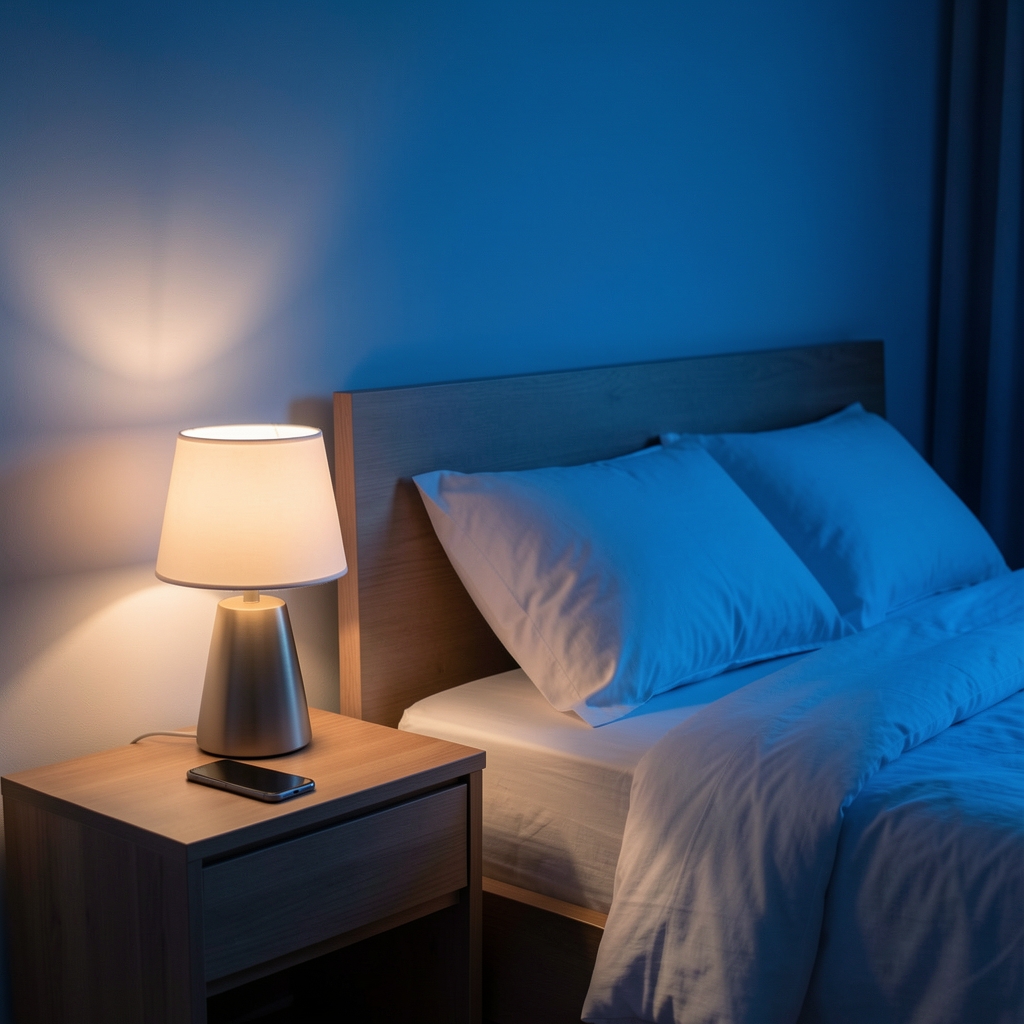
Sleep environment, reduced light — London, 2026
The conversation about evening light and sleep has, in recent years, been almost entirely colonised by the smartphone. Put your phone away an hour before bed. Enable night mode. Use blue-light-blocking glasses. The advice is not wrong, as far as it goes. But it addresses a fraction of the problem while leaving the more significant fraction untouched — and in doing so, it may actually be counterproductive, by implying that the rest of the evening light environment is acceptable as-is.
The research on light and the circadian signal is considerably broader than the smartphone debate suggests. Understanding it properly requires stepping back from the screen question and looking at the full light environment of the home during the two hours before intended sleep onset — overhead fixtures, ambient light from windows, the brightness levels of every surface in a living space. Once you look at the whole picture, the phone becomes a relatively minor contributor to a much larger issue.
The body's internal scheduling mechanism — the circadian system — is primarily entrained by light. It uses light to determine what time of day it is, and it uses that information to schedule a cascade of biological processes: when to be alert, when to begin preparing for sleep onset, and when to initiate the deeper stages of overnight rest. The mechanism responsible for translating light input into circadian signal is a set of photosensitive cells in the eye that are distinct from those responsible for ordinary vision.
These cells are particularly sensitive to short-wavelength light — roughly speaking, the blue-white end of the visible spectrum. They are substantially less sensitive to long-wavelength light at the red-amber end. This is the biological basis for the advice to reduce blue-spectrum light in the evening: it is not marketing, it is a documented property of the photoreceptor system involved.
However, these same cells are also sensitive to the overall quantity of light reaching the eye, not just its colour temperature. A bright amber light is substantially more disruptive to the circadian signal than a dim blue-white source. Lux — the measure of light intensity — matters as much as, and in some studies more than, wavelength. The practical implication is that reducing screen brightness while maintaining bright overhead lighting in the room is an incomplete and potentially misleading intervention.
The most common partial intervention is to reduce screen brightness or apply a warm-colour filter while leaving the rest of the room fully lit. This is better than nothing, but the research context suggests the benefit is modest when the eyes are simultaneously receiving high-lux input from overhead sources.
The studies that show the most consistent improvement in sleep onset timing and morning energy levels are those in which total light intensity in the environment was reduced — not just the wavelength composition of one source. This means overhead lights dimmed to the lowest comfortable level, or switched off in favour of a single low-lux warm-spectrum lamp. It means blinds or curtains drawn if street lighting is present. It means understanding that the eye cannot selectively ignore the bright ceiling fixture while responding to the dimmed screen.
The practical approach that emerges from this framing is a transition protocol rather than a single switch: the environment progressively darkens across the ninety to one hundred and twenty minutes before intended sleep onset, with the most significant reduction happening at the beginning of this window rather than immediately before sleep. The goal is to begin delivering a consistent low-light signal well before the body is expected to enter sleep onset.
"Dimming the room is not preparation for sleep — it is itself the signal that preparation has begun."
The term "screen-free evening" covers a wide range of practices with meaningfully different evidence profiles. Studies examining complete screen cessation two or more hours before sleep onset show the most consistent improvements in sleep onset latency — the time between getting into bed and falling asleep. Studies examining screen use with night mode enabled show mixed results that do not consistently outperform no intervention.
The content engaged with on the screen is a confounding factor that many studies do not adequately control for. A high-stimulation activity — social comparison on a social platform, fast-paced video content, news reading — produces cognitive arousal that is not resolved by dimming the screen. The light reduction is occurring at the same time as arousal elevation, and the two effects partially cancel each other.
A screen-free final hour therefore offers two distinct benefits, not one: it reduces light input and it removes a primary source of cognitive stimulation at the time when the body is attempting to begin its settling process. These two benefits compound in a way that night mode alone cannot replicate. Separating them analytically helps clarify why the partial intervention consistently underperforms the complete one in the research.
Evening light management is most effective when paired with consistent morning light exposure. The circadian system is a twenty-four-hour cycle, and its calibration depends on inputs at both ends: the light that tells it morning has arrived, and the absence of light that tells it the day is ending. Providing only the evening signal without the morning anchor produces an incomplete intervention.
Morning light exposure — ideally natural daylight within thirty to sixty minutes of the fixed wake time — anchors the circadian system to a predictable starting point. It is this anchor that determines how far downstream the evening settling process begins. A well-anchored circadian system begins its settling preparations at a predictable time each evening; a poorly anchored one requires a longer and more deliberate evening light management protocol to achieve the same result.
For those whose working conditions make morning natural light difficult to access — London in winter, office-based roles with early starts — artificial bright-light sources used in the morning can partially substitute. The evidence for artificial morning light is less consistent than for natural daylight, but it is meaningfully better than no morning light exposure at all.
The framework that emerges from the research reviewed here is not complicated. Two hours before intended sleep onset: begin dimming all overhead sources to fifty percent or lower, draw blinds if external light is present, switch any ambient fixtures to warm-spectrum (2700K or below). One hour before: reduce further; primary room lighting off, single warm lamp at the lowest comfortable reading level. Final thirty minutes: no screens. Room at the lowest comfortable light level that still permits quiet activity. Into bed: dark or near-dark environment.
The fixed wake time is the anchor for all of this. Without it, the body has no stable reference point against which the evening signal is timed, and the dimming protocol produces inconsistent results. The two practices are not independent — they are the bookends of the same daily circadian cycle.
What matters most, as with all elements of evening routine discussed in this publication, is consistent application over time rather than perfect execution on any single night. The circadian system responds to pattern. A reliable seventy-five-percent execution rate across thirty days produces more durable improvement than a perfect night once per week surrounded by unmanaged evenings.
Dorvan Journal is an independent editorial publication. Articles reflect the writers' observations on everyday wellness practices and are not intended as guidance for the management of any specific condition. Readers with specific concerns about their daily routines are encouraged to speak with a qualified wellness professional.

Alistair Beaumont is a contributing writer to Dorvan Journal with a focus on the environmental variables that influence rest quality. His work draws on published circadian biology research and emphasises the practical translation of evidence-informed approaches to everyday home and daily routine.
More from the archive